
An ESG assessment is only as reliable as the methodology on which it is based.
raestimo takes a structured, documented, and transparent approach to assessing environmental, social, and governance factors. The goal is to make ESG performance comparable, transparent, and useful for companies, investors, banks, and other stakeholders.
The raestimo ESG rating assesses a company's sustainability performance based on environmental, social, and governance criteria. The focus is on the structured evaluation of ESG-related performance indicators and their comparative classification within the respective industry peer group. The rating serves informational and transparency purposes and does not constitute an investment recommendation, legal advice, or financial advice.
The raestimo ESG rating comprises an overall ESG rating as well as individual assessments for the Environmental (E), Social (S), and Governance (G) dimensions. Depending on data availability and industry context, topics such as emissions, energy, resource consumption, working conditions, diversity, human rights, transparency, and corporate governance are considered, among others.
The overall ESG rating is derived from a consolidation of individual assessments for Environmental, Social, and Governance factors, adhering to a documented methodology. Weighting is applied on a sector-specific basis, accounting for the salience of particular ESG topics within the industry peer group. Comprehensive methodological explanations are provided in the ESG Whitepaper.
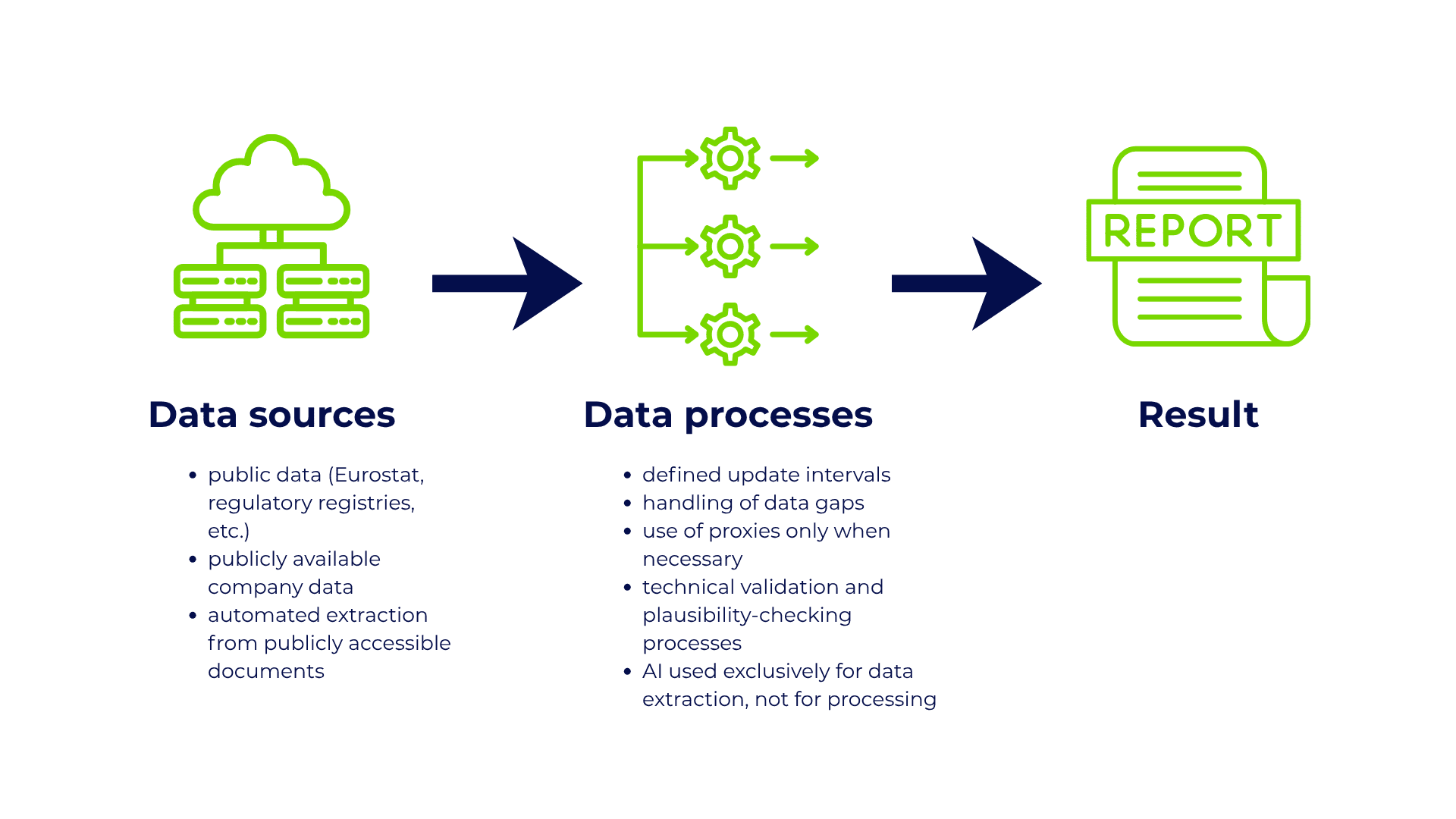
The raestimo ESG Rating is a standardized ESG rating product designed to provide a structured assessment of companies' sustainability performance.
The rating includes an overall ESG score, a rating category, and individual ratings for Environment (E), Social (S), and Governance (G).
The ESG rating can be offered as a public rating, private rating, portfolio rating, data feed, or API-based service.
These deployment models do not fundamentally change the underlying methodology.
The ESG rating assesses a company's sustainability performance based on environmental, social, and governance performance indicators.
ESG-related risks and the impacts of business operations are taken into account to the extent that they can be identified based on the available information and the methodology used.
The ESG rating does not constitute a complete dual materiality analysis in accordance with ESRS.
The ESG rating methodology is reviewed at least once a year and as needed.
Changes are documented, reviewed by subject matter experts, and approved.
Significant changes are documented and published with version numbers.
In particular, regulatory requirements, data quality, methodological consistency, and the impact on existing ratings are taken into account.
Companies can provide information and supporting documentation as part of a structured data collection process.
Companies can report factual errors in the underlying information.
Participation does not influence the methodology, weighting, scoring logic, or rating decision.
Risks associated with automated or AI-powered data extraction may include, in particular, incorrect text recognition, incomplete document interpretation, language or formatting issues, outdated sources, or incorrect assignment of individual data points.
raestimo addresses these risks through plausibility checks, source attribution, data quality logic, validation rules, and documented correction processes. Scores and ratings are not determined autonomously by AI, but rather in accordance with the published raestimo ESG rating methodology.

Significant changes to the ESG rating methodology will be published before they take effect.
The publication must include at least the following: version number, effective date, description of the change, and information on potential impacts on existing ratings
Raestimo’s ESG rating is intended to provide a standardized assessment of ESG factors and does not constitute an investment recommendation or a credit rating. The rating is intended to support informational, analytical, and sustainability purposes.
The raestimo Sustainability Label is based on an ESG rating and defined award criteria.
It is intended to enable companies to present their ESG performance in a transparent and structured manner to customers, investors, financing partners, and other stakeholders.
A label is awarded based on documented criteria, defined evaluation criteria, and established thresholds.
The underlying model is designed to ensure transparency, traceability, and verifiable ESG communication.
For more information on the labeling process and the methodology used, please download our labeling criteria.

The structure of the raestimo ESG rating and sustainability label has been legally reviewed in light of the EU ESG Rating Regulation and the EmpCo Directive.
The legal review confirms that, if implemented appropriately, the model can be structured as an ESG rating and labeling framework that takes into account transparency, governance, and documentation requirements.
raestimo FlexCo
QBC 4, Karl-Popper-Strasse 4
1100 Vienna
T. +43 664 541 36 44
E. info@raestimo.com
